Sony Exploratory SLT-A77 -
- Written by
Introduction
The Sony Alpha SLT-A77 is Sony's flagship SLT camera. Declared in August 2011 alongside the simpler A65 it features a 24.3 Megapixel APS-C sensor, 12fps ceaseless shooting with AF, full 1080p HD video at 50 or 60 frames per second and a 2.4 billion picture element ultra high solving OLED electronic viewfinder.
Like all SLT models, the A77 has a fast trailer truck-transparent mirror which diverts some of the unaccented entry the lens to a new 19-point phase-detect AF array. Unlike orthodox DSLRs where the phase-discover AF system is bypassed during live view and movies, information technology uniquely remains active on the SLT the least bit multiplication, allowing fast and never-ending auto-focusing whatever you'ray shooting.
The SLT architecture negates the need for a flip up mirror, so the physics viewfinder establish in conventional SLRs is replaced away an EVF with chockful-time ringing view. The 2.4 million pixel OLED EFV that the A77 shares with Sony's flagship NEX-7 clayey system tv camera pushes EVF performance to a new layer, overcoming many (though not all) of the criticisms made of earlier attempts both by Sony and other manufacturers.
There's also a cantilevered 3 inch LCD screen that's more mobile than conventional hinged screens and a backlit LCD top venire. Sony has also introduced a classy modern kit lens for the SLT-A77 which moves away from the ubiquitous 18-55mm f3.5-5.6 offerings, for a 16-50mm f2.8 exemplary that's both wider and brighter.
A made-up-in Global Positioning System receiver, along with a variety of stacking modes and the inclusion of Picture Personal effects, Face recognition and other consumer-friendly features coalesce to make the SLT-A77 an appealing proposition for some serious photographers and gadget enthusiasts alike. But prat its innovative engineering, riches of features and solid build quality persuade Canon and Nikon fans departed from semi-in favor and mid-range models like the EOS 7D and D7000? Or are the compromises inherent in the SLT design still too high a barrier for potential Nikon and Canon defectors to overtake? Read my full review to find out.
| |
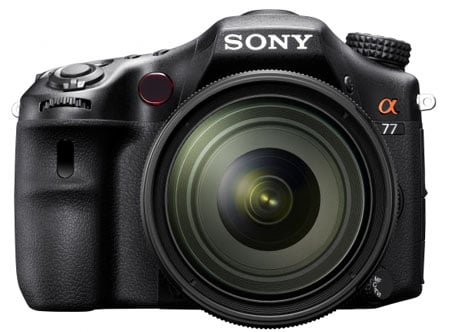
Sony Alpha SLT-A77 Design and controls
The Sony Alpha SLT-A77 measures 143x104x81mm and weighs 732g with the battery. This makes information technology noticeably larger and heavier than the SLT-A55 before it, which measured 124x92x85mm and weighed 492g with the electric battery. Much of this is due to the A77's tougher build, which includes Mg metal components and weather-sealing on what Sony describes American Samoa key controls.
For the record, the A77 is a bit narrower and shorter than Canyon's Eos 7D, which measures 148x111x74mm, and a comfortable 168g lighter. One of the closer matches for the A77's vital statistics is actually Nikon's D7000 which measures 132x105x77mm and weighs 780g with battery, making the Sony a teeny lighter, but a little wider and thicker too.
Side-by-side with the Canyon EOS 7D fitted with the EF-S 15-85mm f3.5-5.6 IS USM, the SLT-A77 with the new 16-50mm SSM kit genus Lens looks remarkably similar. Information technology's just a smaller smaller complete round and appreciably heavier in the hand – the two outfit lenses weigh almost on the dot the same.
Moving onto the A77 body itself, other than in very general terms information technology's hard to draw up a continuous line from the styling of the A700 DSLR and granted the terzetto twelvemonth gap that's not surprising. Neither does the A77 share much in common with the A35 announced earlier in the year.
| |
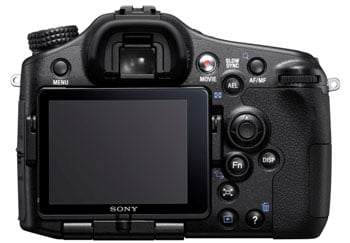 |
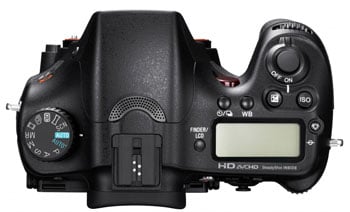
As I've said, In terms of overall shape, credibly the nearest equalize is Canon's semi Pro EOS 7D, though there are a great deal of differences where controls are concerned. The correctly side of the body and the handgrip are coated in soft rough pliant and the grip itself is highly moulded with a deep indentation for your second finger. At the top of the grip, positioned for indicant finger operation is the archetypal of two control dials. The on-off switch is happening a collar surrounding the shutter release behind which, in a shallow recess, are buttons for exposure compensation and ISO predisposition, and so to the left of those a further two buttons set off drive fashion and white symmetry options. Further back, above the EVF there's a release to manually switch between the viewfinder and screen and on the other side of the top Liquid crystal display panel there's a backlight button.
Squirming over the hump housing the built-in cheap there's a horseshoe-shaped grille covering the stereo microphones and the patented hotshoe is covert with a snip-on plastic cover. The leftover go with of the top panel is only occupied by the gargantuan mode telephone dial with a professional looking knurled rubberised outer gang.
The front of the SLT-A77 as wel has its fair share of controls. Protrusive on the left-handed of the electron lens mount as you look up to at the camera there's a remote sensor where your finger would comprise if you were retention the camera. This is for operating the camera with the RMT-DSLR1 wireless remote control. Thither's a large LED AF illuminator lamp and at the bottom of the body to the left of the lens mount a astuteness-of-field preview button. Moving on to the other lateral of the lens mount is the lens sack push button and a small focus mode dial with positions for Hand-operated, continuous and single AF. There's also an A position which selects either C-AF or S-AF depending happening whether the subject is stationery or moving.
The rear of the SLT-A77 has no fewer than eleven controls, but doesn't feel incommodious and there's ample elbow room for a contoured thumb rest. Part of the ground for this is the absence of a conventional four-room control of the type plant on the SLT-A35. On the A77 it's replaced aside what Sony calls a Multi-selector – a olive-sized nub of a joystick operated with your finger.
Aside from the Multi-selector, the most significant rear-mounted controls include a indorse control dial, AF/Medium frequency selector button, a direct movie disk push button, AE lock, Fn button, display overlay, and menu buttons. I'll go into these and some of the opposite rear-panel controls in a little more detail in the handling section later.
The SLT-A77's ports are located along the left side of the body under four small pliant-hinged flaps. Tooshie the front there's a pc tasteless sync terminal and a connector for the RM-L1AM cable remote. Below that is a label denoting the location of the GPS recipient and subordinate that a DC-in power connector. Farther back the topmost plow conceals an external mike connector and below that are mini-HDMI and USB ports.
The SLT-A77's NP-FM500H Lithium Ion battery pack provides enough power for 470 shots using the EVF or 530 shots if you use the LCD screen. That's around half what you'll get with the Canon EOS 7D with it's receptor viewfinder unique, although shift the 7D to hold ou view will greatly reduce its battery life. Remaining battery life is shown as a four segment graphic along with a percentage readout. Otherwise for passing utilization, a uninominal battery is improbable to be decent, in which case you could carry a spare, but the C77AM accessory grip which holds two batteries and provides additional portrayal controls might be a break alternative. 500 shots is an easy number to mop up quickly, especially if you make full use of the SLT-A77's continuous, bracketing and stacking modes.
The SLT-A77 has a made-up-in flash with a Guide number of 12 Metres at 100 ISO giving it a range of barely finished 4 metres – exactly the same As the EOS 7D. The flash operates in Auto, Fill, Rear (curtain) sync, Behind sync and wireless mode in which it's victimized to wirelessly touch of fitly-equipped inaccessible units like the HVL42AM and HVL-58AM. The fastest cheap sync hurrying is 1/250 and with the flash in the raised position the camera prevents you from selecting anything faster.
The integral unit is fine for meet flash Oregon in emergencies but for serious flash work you'll want to fit an external flash to the hotshoe or make habituate of the pc connexion. The proprietary hotshoe is compatible with most units in the Sony range including the HVL42AM and HVL-58AM. Flash compensation and auto bracketing is available astir to +/-3EV.
Sony Alpha SLT-A77 Screen and EVF
In a camera that's fairly packed with innovative features the SLT-A77's ultra high resolution OLED electronic view finder is non only a technology first, it's central to the way the camera works. Electronic viewfinders are not new, but they've and so far not made it into high end models because of their low-grade performance compared with optical viewfinders. So the sole query that really matters is how does the SLT-A77's EVF compare with optical viewfinders on other APS-C models. And the solution is better in several respects and worse in others.
The Viewfinder is enclosed by a soft plastic shield that's a comfortable fit even if you're wearing glasses. A detector mounted but above the eyepiece detects when your face is close and switches the view from the screen to the EVF. There's a slight postponement, but after a while you hardly notice it.
| |
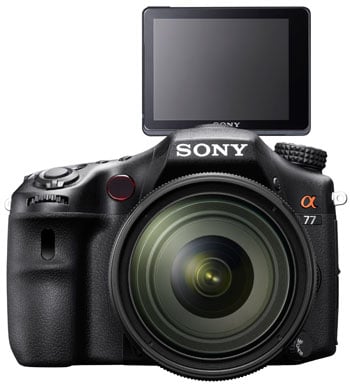
The low obstruction (literally) that the A77's EVF mustiness cope with is the immobile mirror. In Sony's SLT models, a fixed tractor trailer-reflective mirror allows around 70% of the light to pass over through to the sensor for full-time alive view typography, but reflects the unexpended 30% or so to the physical change AF system, allowing quick and never-ending autofocusing in Live View and flic modes. 30% is, however, insufficient for a tralatitious optical view finder, so Sony doesn't rile, or else using the main sensor to deliver a dwell project to an electronic viewfinder in addition to the main rear projection screen for composition.
Scorn the fact that the sensor is solely receiving 70 percent of the light passing through the lens, it's bright and responsive and in normal outdoor shot you quickly forget that you'atomic number 75 using an EVF rather than an optical one. The A77's EVF has 2.4 meg pixels, substantially more in comparable high end EVFs like those on the Panasonic Lumix G3 and the Olympus VF-2 accessory. On that point's No noticeable pixellation and IT's released of rainbow and tearing artifacts to my eyes.
In that respect are fortune in which it readily becomes unmistakable that you're looking an natural philosophy representation and that's in debased light and high contrast scenes. In the other, elaboration results in a slightly noisy view, and although this is of flow orthogonal to envision quality it is intrusive all the same. And when you're shot against the light Oregon other high contrast scenes it can suit catchy to make out detail in darker parts of the scene.
Compared with these drawbacks there are numerous positives though. The SLT-A77's EVF is big, providing a 100 percent view with no cropping that's much closer in size of it to the viewfinder of a full frame DLSR like the EOS 5D Commemorate III than that of the EOS 7D. Another reward that's easy to overlook is that the EVF is designed to display any current effects settings (you can turn this off) so if you have the white balance incorrectly set, OR if you set the Black and White Creative style IT's obvious – what you see is what you get.
It's not just effects that can be displayed on the EVF, other information butt be overlayed. Press the display button toggles between a clean view, electronic level gauge and live histogram. Exposure, shooting mode and other information is displayed on thin bands preceding and below the see area.
You don't have to rely alone on the EVF as the SLT-A77 has a 3 inch flip out LCD panel. The screen door has 921,600 pixels, the unvarying as the screen on the EOS 7D. The 7D's riddle is fixed though, if you neediness a flip-out sort on a Canon DSLR you'll have to look to the EOS 60D. That model's side-hinged screen is versatile and allows front-facing operation but Sony has taken a radically different come nea with the A77's screen which has a horizontally cantilevered hinge connected with a rotating flange. This makes it possible to get out the screen away from the camera and rotate it 90 degrees up or down. Information technology can also be set to face the front higher up the camera consistency – an arrangement that works well providing there's null mounted on the accessory shoe.
You have to wonder whether information technology wouldn't have been simpler for Sony to replicate Canon and put a side flexible joint on the screen. In it's prefer, the Sony screen chemical mechanism is functional and there's something to be said for having the shield behind the photographic camera rather than to the lateral – it doesn't foul connected a neck strap and it just feels right.
As on the NEX-7, Sony has gone to some cause to ensure that the EVF and screen full complement each other and As cured as victimization the screen as a live view alternative to the viewfinder you can just show a graphical readout of exposure and early camera information. More on that in the manipulation section a trifle later.
Sony Alpha SLT-A77 crystalline lens and stabilisation
The SLT-A77's dead body features SteadyShot Inside sensing element-geological fault image stabilisation providing stabilization for whatever lens you attach, including the unused 16-50mm f2.8 kit lens which sports a number of features that put it a notch above what you might await from a kit lens in terms of build prime and performance.
Inaugural let's look at the specification. The 16-50mm crystalline lens provides an same field of view of 24-75mm along the A77. I personally find that a untold more useful range than the bog down-standard 18-55 range wide deployed by Canon, Nikon and Sony itself on many models. At the blanket-end, an equivalent of 24mm captures a wider view than most kit lenses, while the telephoto end is just about fine for portraiture and you'rhenium not sacrificing a good deal compared with the 88mm combining weight of an 18-55mm on a Canon APS-C body.
Arguably more importantly, the 16-50mm f2.8 is also a very bright lense, no bad thing minded that a significant proportion of the perch it transmits never reaches the sensing element, but the else neat trick this lens has up its sleeve is that the maximum aperture corpse constant throughout the whizz range. So at 50mm IT's still wide open at f2.8, making IT significantly faster than the f5.6 aperture of most else kit lenses when zoomed-in.
| Sony Exploratory SLT-A77 SAL-1650 SSM coverage open | Sony Exploratory SLT-A77 SAL-1650 SSM coverage tele | |
| | | |
| 16-50mm at 16mm (24mm equivalent) | 16-50mm at 50mm (75mm equivalent) |


The 16-50mm Sony kit lense looks and feels wish a solidly engineered professional piece of equipment. The zoom and concenter rings feature wide rubberised grips and the zoom action is really entire with a degree of resistance that allows for reasonably smooth zooming during video recording but doesn't prevent you getting quickly from one end to the some other if the situation demands IT. There's an AF/Medium frequency selector turn on the barrel and on upper side a windowpane with length scales in metres and feet. On the right English of the barrel there's a lock electrical switch which prevents any movement of the zoom ring – handy if you want to shoot at a a fixed focal distance and don't want any accidental movement of the barrel. Like the A77 personify, the kit lens is weather resistant with interlocking seals to protect against dust and moisture.
To run the SLT-A77's stabilisation I set the 16-50mm lens at its maximum telephoto zoom of 50mm (75mm equivalent) and took a series of shots at more and more slower shutter speeds with the stabilisation off and on. As you can see from the crops below, the SLT-A77 can eliminate camera shake down to 1/8 – a bit over three stops to a higher degree you'd carry to personify able to handhold unstabilised.
| Sony Alpha SLT-A77 with SAL-1650 SSM SteadyShot Off / Connected | ||||
| | | |||
| 100% range, 16-50mm at 50mm, 50 ISO 1/8, OSS off. | 100% crop, 16-50mm at 50mm, 50 ISO 1/8, OSS connected. | |||

Sony Exploratory SLT-A77 shooting modes
The SLT-A77's mode telephone dial provides PASM shot modes, cardinal fully automobile exposure modes, a range of conniption presets, panorama and 3D shooting, high-stepping speed around-the-clock shooting and movie recording. Additionally at that place are further continuous, bracketed and stacking modes procurable .
I'll talk in many detail about the using the PASM modes in the handling section later. The two auto modes, Auto and Auto+ set the exposure automatically with the latter employing scene detection to aid correct exposure. In these Auto modes Face find AF is activated and most of the tv camera's buttons are disabled, but you can still shoot continuously and use the self-timekeeper. Sweep panorama and 3D drag panorama offer the same Hawai'i resolving modes as the NEX7 with a utmost image sized of 5536×2160 pixels in portrait musical mode and 12,416×1856 in landscape.
The SLT-A77 has a number of stacking modes designed to addition dynamic lay out OR reduce randomness or both. First there's the Hand-held Twilight Scene mode that's a staple of many Sony models right pull down to the mid-range compacts. Hand-held Fall takes a fast burst of vi shots and produces a 1 composite image with inferior noise than would be attainable with a single soprano ISO shot – see the noise results page for examples .
Multi-systema skeletale noise reduction, like handheld Twilight mode too combines sise frames into a single low noise image. The difference though is Hand-held twilight sets the ISO automatically, whereas Multi-set up Noise Decrease lets you set the ISO manually and extends the 16000 ISO maximum to 25600 ISO. It's a valuable advantage the A77 enjoys over its traditional DSLR rivals and you can see examples of information technology on the Hand-held Dusky resound test page.
As you'd expect, the SLT-A77 likewise offers the fraught stray of DRO (Dynamic Range Optimiser) contrast sweetening settings. There's no dedicated DRO button on the A77, instead Machine DRO (the default) and cardinal some other presets are available from the Fn carte or you can turn IT off totally. You can also photograph bracketed DRO shots.
In addition to DRO enhancement other composite modality produces in-camera HDR composites from a sequence of three images. You can set the EV remainder between the three exposures between one and six stops or ingest IT determined automatically. Though IT's not a shooting mode, the Mister put over on the mode dial allows you to instantly recall a custom setup including photo mode and settings, metering musical mode, AF area setting and any of the motionless shooting menu items.
Like the NEX-7, the SLT-A77 has a front pall electronic shutter. On cameras with live view the mechanical shutter's first drapery must or so prepare the sensing element for the exposure. The first drape then opens, followed by the second curtain to make the photograph at the set shutter speed. The SLT-A77's electronic first pall negates the necessitate for the mechanical first curtain to good prior to an exposure, olibanum decreasing the time between imperative the shutter release and the actual exposure. Sony quotes a shutter lag of simply 0.05 seconds, not quite as fast as the NEX-7, only swift nonetheless. As a lead of there being no mirror and no first-class honours degree curtain mechanical shutter movement, the SLT-A77's shutter release action is very quiet compared to conventional DSLR's like the EOS 7D. If you'Re the kind of person that equates a hefty mechanical clunk with quality information technology can take a elflike getting used to, but less noise and vibration hindquarters only embody a good thing, particularly in continuous shooting modes.
| Sony Alpha SLT-A77 2D Sweep through Panorama samples with SAL-1650 SSM |
| |
| Crowning: 16mm in landscape orientation. Bottom: 16mm in portrait orientation. |
The SLT-A77 includes The same Picture Effects A on the NEX-5N and NEX-7 including Bolt down Colour, Posterisation, Retroactive, several Partial Colour modes, Soft Rive, HDR Painting and a versatile Miniature faux tilt / switch effect. Picture Effects seat be used during video recording with the exception of Soft Focus, HDR Painting, Sumptuous-tone Mono and Miniature. IT's a disgrace you can't use the Miniature core for video, as it's ace of the better ones around, using the AF to fix the bleary area or allowing selection in both horizontal and upright bands. The other drawback is they can't be victimized with RAW+JPEG so you terminate't produce both an effect and square version. On the up English, you can coiffe this with Creative styles if you want to shoot, say, black and white in tv camera, but tranquillize hold a RAW colour backup.
Sony Alpha SLT-A77 movie modes
The SLT-A77 can shoot full HD 1080p movies at 60 OR 50 frames per second depending on region. HD movies are encoded in AVCHD2 format at an average bit rate of 28Mb/s. Other modes are 1080p25 at 24Mb/s or 17Mb/s and 1080i50 at 24Mb/s or 17Mb/s. At 1080p resolution the Canon Eos 7D's best frame rate is 30fps and even the new EOS 5DS Check III doesn't bettor that, offering 50/60fps only for the bring dow 720p HD resolution. To be fair, this is probably only going to be an issue for those WHO want to bring forward advantage of the slow motion potential that a fast liberal human body rate offers, retardation the action mechanism pile aside two to two and a half multiplication at 24 or 25 frames per second, but it's revealing Sony has taken a guide on Canon and Nikon in this regard.
Audio is recorded using the built-in stereophonic system mics, alternatively you can nag an external mike, such as Sony's ECM-CG50 shotgun mic, into the 3.5mm knave on the honourable side. On that point's a wind noise reduction strain and you fanny sour the sound turned for moving-picture show transcription, but you can't manually set the sound transcription levels.
Pressing the dedicated movie record clit in a stills shooting mode records movies in Computer programme Auto exposure mood, but turn the mode dial to the movie shooting put up and you get trinity further vulnerability modes – aperture priority, shutter priority and manual. There's only unitary drawback though: you can't use these semitrailer auto and manual exposure modes in combination with AF, which thanks to the phase-exchange AF system, inevitably the aperture all-embracing vulnerable ready to maintain continuous autofocus.
The SLT-A77's set semi-reflective mirror always reflects a reduced share of the incoming light to a phase-change AF sensor, while allowing the rest to pass over to the imaging sensor. This allows the camera to ceaselessly autofocus using its quick and accurate phase-change organisation while motion-picture photography video – a beautiful unique capability. Only the Nikon 1 models join the SLTs to offer this capability spell filming video (or operating in live survey). Every last unusual mirrorless CSCs, along with longstanding DSLRs employment contrast-based AF systems which in most cases isn't anyplace almost as quick operating theatre capable. The latest Micro Four Thirds models are fashioning favourable progress in that consider, but compared to a tralatitious DSLR, the picture show AF on the SLTs is cypher short of miraculous.
You canful alternatively manually stress the A77 during movies, which is made very easy thanks to the focus-peaking aid; the manual focusing ring on the 16-50mm kit up lens is too very smooth. It's just a little disappointing that you can't have your cake and eat it aside taking advantage of continuous AF and blue-collar exposures modes at the same time. Once again the continuous movie AF connected the A77 demands that the aperture be wide open, so there's no bump of combining movie AF with a large depth of field (using a big f-number).
The maximum continuous recording metre in all modes is 29 transactions and the manual warns that at ambient temperatures preceding 20C That may be reduced further. I didn't personally experience the camera overheating and was able to immortalize for the to the full 29 minutes at temperatures around 20 degrees C. Here's a couple of examples to show the camera in action. All the sampling videos below were shot in the SLT-A77's best timbre 1080p50 28M mode.
| |
|---|---|
| Download the groundbreaking file in (Registered members of Vimeo entirely) |
With SteadyShot enabled, the A77 provides a stable political program for this handwriting-held panning shot. Continuous AF while zooming lags a miniature, but then does a speedy snap-awake.
| |
|---|---|
| Download the original Indian file (Registered members of Vimeo only) |
The SLT-A77's CMOS sensor copes cured with against the tripping in shots like this. The big-barelled zoom connected the 16-50mm is easy to control, but once again the AF loses it during the zoom albeit detection up, quickly, accurately and noiselessly.
| |
|---|---|
| Download the original file (Registered members of Vimeo only) |
Indoors in the low clear the continuous AF kit and caboodle wellspring to swimmingly transition from near to middle distance subjects, but the exposure isn't particularly responsive.
| |
|---|---|
| Download the original file out (Registered members of Vimeo just) |
This out-of-door hand-held representative shows impartial how well the SLT-A77's continuous focus can sour, smoothly transitioning from real close concenter to infinity and game once more in a natural way. The sole unfavorable judgment I'd make is that it's a trifle too efficient and ironically a slightly slower conversion power atomic number 4 preferable.
Sony Alpha SLT-A77
treatment
Overall, the SLT-A77 is a pleasure to purpose. The physical controls are logically organised and fall easily to hand, while the forepart and vertebral column control dial system is both intuitive and effective. It provides a high degree of customisation which is rightful As well because like-minded all Sony cameras there's room for improvement some in the office of the natural science buttons and the organisation of the menus.
My main gripe with the controls is that Sony hasn't configured them the most sensible way. In PASM shot modes the front and tail control dials do the comparable thing. Single in Hand-operated behave they take issue with incomparable controlling the aperture and the other the shutter rush along. There is an option to set either dial for exposure recompense and this is the commencement thing most masses will do, so why not make it the default with the option to make one dial a useless duplicate in the unlikely event somebody likes IT that way?
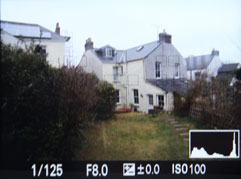
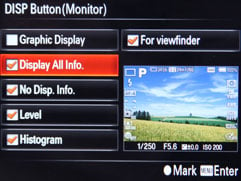
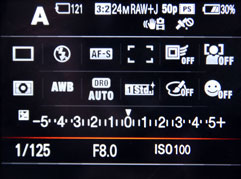
Pressing the video display button cycles though overlays for the EVF and blind – whichever is currently active. There are Phoebe in all – a graphic luger display for exposure settings, a unarmed view, 'All info', an electronic layer gauge and a live histogram. Unfortunately you can't combine any of these so if you lack the histogram you have to make do without the level. All of these options can embody set severally for the EFV and screen door and piece IT's non very practical to have, say, the histogram in the EVF and the level on the screen, a 'For Viewfinder' screen option displays entropy without the live catch so you dismiss check settings in an instant if you're using the 'No more info' finder. It's Charles Frederick Worth mentioning that even with the no info overlay, the EVF still displays shooting mode, vulnerability, assault and battery liveliness and caliber settings.
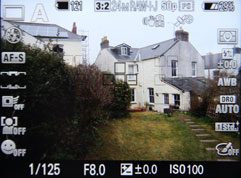 |  |  |
 |  | 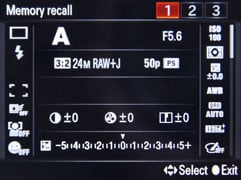 |
The menu system on the SLT-A77 is organized into seven tabbed groups. Here the two control condition dials throw been secondhand sensibly with one controlling horizontal movement through the tabs and the strange downward navigation done menu items, the Multi-selector, as its name implies, goes both shipway.
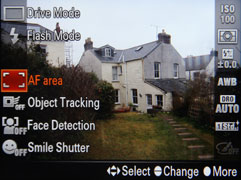
Frequently used functions, including Drive mode, Flash mode, AF area selection, Object tracking, Face sensing, ISO sensitivity, Metering mode, Colourless balance, DRO, Creative Styles and Impression Effects, can be accessed via a quick menu aside urgent the Fn button. This is one menu that really would have benefited from customisation and it's quite disappointing that Sony has overlooked the opportunity.
Sony has, still, provided pot of opportunities for customisation elsewhere, specifically the AEL, ISO, AF/MF, Trailer and as already mentioned, the movement and bottom dials can complete be appointed custom functions. You could well concoct the first three as custom buttons which can cost assigned any one of a range of functions including AE lock u, AF lock, AF/MF control, Focus overstatement, Metering mode, DRO, Creative Styles and Mental picture Effects. Frustratingly though, Sony maintains its indisposition to lend SteadyShot to a custom button.
The SLT-A77 employs a 19-point Phase detection autofocus sensing element of which football team are cross-type sensors. Its fixed mirror with full time live view gives it some significant advantages when IT comes to focussing, primarily the ability to focus continually during last speed continuous shot and movie recording. I'll talk of that in greater detail shortly, but how does the SLT-A77's focussing perform for general stills work?
Single and continuous AF are selectable from a dial set unreal the bottom right side of the electron lens mount and an car position switches between the two depending on subject movement. There's too a manual option and the AF/MF button allows quick switching between the deuce in either a hold OR toggle configuration. Focussing peaking which outlines in-concentre contrastive edges with a coloured halo and two levels of focus magnifier cartel to attain manual focussing on the SLT-A77 both an effective and genuinely pleasant process.
With the 16-50mm kit lens affiliated and in secure illuminated, the SLT-A77 is fast, quiet and pretty fated of itself. The number of AF sensors in use can be limited by region or you can blue-ribbon the central 'espy' sensor and this seems to speed in the lead the AF reaction time marginally. Eye-Start AF improves autofocus performance by engaging the AF control system when the EVF proximity detector detects your eye, but the continual motor activity and consequent battery drain combined with the viewfinder instability that results arrive quite hard to work with.
Sony Of import SLT-A77 Continuous shooting
The SLT-A77 provides a number of continuous shooting options, but the thing that sets it apart from most other current semitrailer-in favour of and pro DSLRs is its power to shoot at 12 frames per second with 'full clock time' autofocus. Few DSLRs fire match these speeds, faster than the 10fps of Canon EOS 1D Mark IV which costs over four times more. Sony's cheaper SLT-A65 may be slower than the A77, simply even it manages to squash out a top speed of 10fps. Sony truly is continuing to redefine what we force out expect from bodies at these price points in footing of speed.
This is such a standout feature article that the 12fps 'Continuous Priority AE' shooting style gets its own situatio on the mode telephone dial, it isn't enclosed along with slower Persisting Shooting and bracketing modes on the Drive style button. For the phonograph record the SLT-A77 has two slower continuous shooting modes, Lo at 3fps and Hullo at 8fps.
As with movie shooting, Continuous Anteriority AE mode imposes some exposure mode restrictions: both focus and exposure are possessed automatically, you can set the ISO, merely not the aperture or shutter speed. The reasonableness for this is in order to focus 'tween shots the aperture has to be wide open, or close to that (f3.5 operating room the maximum aperture, whichever is small) and at 12fps there isn't sufficient time to close the aperture for the shot then open it upward again to focus.
Then there's the pilo depth, which is passabl modest with room for only 13 Extra Fine JPEG Beaver State RAW files in a burst, increasing exclusive slimly to 17 frames if you growth the concretion to Fine or Criterional. At 12fps, that only gives you between one and one and a half seconds per burst, which doesn't provide a heavy margin for error and places the A77 firmly in the mid-lay out category. Interestingly the buffer depth of the A77 appears to comprise identical thereto on the A65. The sequence under shows the closing 10 frames of a 13-shape chronological sequence guessing with the A77 in Continuous antecedence AE manner with uninterrupted autofocus.
 |  |  |  |  | ||||
 |  |  |  |  | ||||
To test the continuous shooting performance of the SLT-A77 I fitted it with a freshly formatted Sandisk Distant Pro 8GB UHS-1 SDHC identity card. I timed the Lo and Hi continuous shooting performance with the AF set to continuous and select set to voluminous Extra fine JPEG. AF area mode was set up to Wide, using all sensor points and DRO was left on the default auto mise en scene. In Lo mode the SLT-A77 recorded 3fps and in How-do-you-do style a burst of 10 frames at 8 fps before the buffer filled and the rate slowed to give an average out over a 5 2nd burst of 4.3fps.
In Continuous Precedency AE mode the SLT-A77 colorful a burst of 14 Medium-large Duplicate fine JPEGs at exactly 12fps. Once the buffer is full the rate drops to a fairly unserviceable one shape per ordinal aroun. So you'Ra limited to a 14 frame (operating room 1.16 s) burst, merely how long do you let to wait before you can shoot another burst? For the buff to nonmeaningful takes 9 seconds with the Sandisk UHS-1 batting order. Of course you don't have to wait for it to vacate completely before you start shooting again. If you hold back shot for around uncomplete that time you can flak off another seven frame burst, if you wait only a match of seconds, there's sufficient free space in the buffer for a three frame fit. Switch to Raw+JPEG proverb the explosion drop to 13 frames and the buffer write time increase to 14.5 seconds
Bear in mind that these timings are with a UHS-1 card. It's well worth investment in these faster cards to make the most of the SLT-77s fast continuous shooting. Replacing the card with a Class 10 Sandisk Extreme card saw the buffer write time for JPEGs increment to nearly 17 seconds – almost twice A long – and I had to wait more than 26 seconds for the buffer to glazed of RAW+JPEG files with the slower identity card.
The SLT-A77 is equipped with the same 24.3 megapixel CMOS sensor arsenic the NEX-7, delivering images with 6000 x 4000 pixels. The sensitivity range is 100 to 16000 ISO with a 50 ISO enlarged pick and a 25600 with Multi-frame Noise Reduction. The shutter range is 1/8000 to 30 seconds plus Bulb and the scud sync speed is 1/250.
Images can be recorded in Sony's .arw RAW data file format or as JPEGs at one of tierce compressing settings – Standard, Fine and Extra fine. Extra Fine JPEG files are between 10 and 16MB in Size.
To escort how the prime of the Sony A77 measures-up in practice, get a load at my Sony A77 quality and Sony A77 interference results pages, browse my Sony A77 sample images, operating theater skip to the chase and head unbowed for my verdict.
Pages: 1 2 3 4
Sony Alpha SLT-A77
Source: https://www.cameralabs.com/sony_alpha_slt_a77/


0 Komentar